Friday, February 26, 2021
More Details on 10X's Sample Profiling Trident
10X Genomics had an online event Wednesday called Xperience (as far as I could tell no Jimmy Hendrix music was used, a missed opportunity!) to lay out their development roadmap. This largely paralleled the presentation given at J.P. Morgan, but there were a few new bits and of course much more technical detail to whet the appetites of scientists -- and judging from a number of very positive tweets I saw today they were successful in that goal. Some of the 10X management was kind enough to walk me through the deck earlier this week as well as permission to borrow images from it, so this summary is based on that as well as watching the presentation. While their name is 10X, the company emphasized progress on three axes: scale, resolution and access and that progress across the three different platforms.


Tuesday, February 09, 2021
Could I See Myself at J.P. Morgan?
There's a question that others pop my way pretty much every year around J.P. Morgan: would I ever attend myself? I'll confess it never occurred to me before I was asked, but that isn't necessarily a deal breaker. I foolishly didn't attend AGBT until 2013 when Alexis Borisy (then CEO of Warp Drive) suggested I go -- I think it was mostly because he thought it was a good investment and probably only secondarily to keep me off the ski slopes for a week -- I shattered my knee just after AGBT 2012 ended. It's an interesting but complex question which I will answer one way here, but freely admit that over coffee I could be nudged one way or the other.
Monday, February 08, 2021
Why I Hated One Genapsys Slide
I claimed in my Miscellanea piece that I was one post away from being done with J.P. Morgan -- oops, forgot I had drafted a minor screed on data display which I'll push out before the last piece - particularly since I hinted I would be taking Genapsys to task on this subject. Unexpectedly good timing too: maybe new Genapsys CEO Jason Myer's first big initiative can be to fix this plot!
Saturday, February 06, 2021
J.P. Morgan: Miscellania
Before J.P. Morgan is truly a month ago I should clean up some loose ends as a penultimate post driven by this year's virtual conference (the last post isn't exactly time sensitive). In contrast to the single company focused items that preceded it, this is a grab bag of minor observations and notes.
Thursday, January 28, 2021
J.P.Morgan: NanoString
Almost done with my J.P. Morgan summaries -- this will be the last focused on a specific company: nanoString. They wish to emphasize that they are becoming the company for spatial analysis of DNA, RNA and proteins in biological samples. They also want us to differentiate that space into two segments: profiling and imaging. Profiling gathers spatial information from regions of multiple cells; imaging in their lingo covers spatial techniques with single cell or subcellular localization. In both cases nanoString is betting heavily on oligo-tagged antibodies to enable deep multiplexing of protein detection to be integrated with RNA and DNA detection.
Monday, January 25, 2021
J.P. Morgan: Genapsys
Genapsys' J.P. Morgan presentation by CEO Hesaam Esfandyarpour focused on their story of delivering a compact sequencer based on electronic detection that offers low capital, low cost sequencing. There were two bits of specific product news, but mostly general painting of a rosy picture.
Tuesday, January 19, 2021
J.P. Morgan: PacBio
PacBio CEO Christian Henry’s presentation at J.P. Morgan wasn't rich in technical specifics. But he gave a very bullish portrait of a company aiming for the stars. A conflict reminder: he’s a member of the Board of the Strain Factory that employs me, though I haven’t yet had the pleasure of meeting him.
The biggest news is a broad partnership with Invitae four clinical human genome sequencing. The only specific here is that this is not the whole enchilada; platform development will take place both within the Invitae collaboration and outside it. What might that development be?
Between Henry’s comments in the Q&A and a few info crumbs on slides there will be pushed to further tune all the canister. Her mentioned efforts on dyes and further improving SMRTcell loading efficiency. There was chatter on Twitter about an overdue update to improve HiFi yields.
Henry talked of the importance of increasing ZMW packing, but gave no specifics other than to suggest this is more "development" than "innovation" -- this was in response to a question asking if technical breakthroughs are required. But we are left wondering on a timetable as well as what the next density might be; four-fold to 32M wouldn’t be surprising on naïve geometry grounds.
I suspect a huge area of joint effort with Invitae will be to automate HiFi library production. The current protocol is long, manual and labor intensive - not at all appealing for lease scale clinical use. How much of that will be retained as proprietary to Invitae will remain to be seen. Henry claims that the Invitae effort will be separate but coordinated with existing development efforts; prior plans have not been shelved or diverted to support Invitae. A major software effort to support clinical operations is a given. PacBio has separate workflows for SNP and SV calling and those must be integrated and a clinician-friendly report generated.
Henry believes that the new Sequel IIe will be the dominant product shipped going forward. It will be interesting to see which of the older workflows PacBio updates and moves into the on-board compute. For example, if you want to call methylation you must export BAM files with kinetics data, which are predicted to be five-fold fatter. If the methylation calling happened on board, then that extra processing and extra data would be eliminated.
Similarly, workflows such as microbial assembly are still based around Continuous Long Reads (CLR). Henry didn't mention CLR once (I think). While I doubt they would ever dump it altogether like they did Strobe Reads, it would seem likely that it won't get much attention. Oxford Nanopore can beat them on very long reads and their single molecule accuracy is much higher; far better to focus on the CCS/HiFi reads where PacBio can deliver much higher accuracy. It will be interesting to see if PacBio pushes the HiFi fragment read length longer. On the one hand it will be more challenging to work with longer fragments and to routinely get enough circuits around them to deliver HiFi quality data. Twenty five kilobases is a nice size for many applications, but there will always be incremental value for going to thirty or forty or beyond.
In response to a question about $1000 genomes, Henry described it as "just a number" around "where it makes sense" in high throughput applications. He says the Invitae collaboration will be able to drive prices below $1000. But he also pushed the idea that a PacBio genome is a truly clinical grade genome and has higher value than genomes produced on other platforms. He argued that this higher value, in terms of higher diagnostic yield for rare diseases, will be more attractive to payers and that there will be a net benefit to the healthcare industry by ending diagnostic odysseys sooner. He vowed to continue generating "diagnostic proof statements" to provide evidence to support the higher value claim.
Should be interesting to watch, particularly if you have a front row seat in front of a Sequel IIe,
Saturday, January 16, 2021
J.P. Morgan: 10X Genomics
As I attempt to collate various incomplete thoughts about the J.P. Morgan presentations I have read and listened to from genomics instrument shops, one thing stands out about 10X Genomics: they actually announced new gadgets and kits! I should thank the company for supplying the slides after I snarked on Twitter about how they weren't archived in the J.P. Morgan webcast -- but now it is there. So either my eyes failed again or I had a personal IT failure (I think the website doesn't like iOS and I may have forgotten that). The slides were presented by CEO Serge Saxonov
Thursday, January 14, 2021
JP Morgan: Illumina
Illumina presented at J.P. Morgan on Monday, reminding us that they aren't just a sequencing instrument company but an interlocking set of businesses focused on genomics. CEO Francis deSouza spent much of his time discussing the Grail acquisition and some of the other ways in which Illumina is pushing rapidly to become an essential part of clinical medicine, but there was one slide on future improvements to sequencing technology and a few on the lineup of existing sequencers. Reminder: I'm working off public sources, as during the day we work closely with Illumina and they even sunk some serious cash into my employer last May.
Monday, January 11, 2021
J.P. Morgan 2021
The J.P. Morgan Healthcare Conference has started this morning in virtual form, so I'd really better get this draft cleaned up and out (indeed, Roche is presenting as I hurriedly type, though about pharma not diagnostics). 2021 already feels like a darker continuation of 2020, between the appalling putsch attempt in my nation's center of government last Wednesday and the still buggy roll-out of the coronavirus vaccine. As I noted in my piece on the Oxford Nanopore Community Meeting, the many disruptions of 2020 make grading the progress of companies essentially impossible: many were disrupted by lockdowns, supply chain issues and the general distraction from the year of doomscrolling.
Sunday, January 03, 2021
Advent of Code vs. FizzBuzz
A bunch of coding types at the Strain Factory participated in The Advent of Code, a clever 24-day set of programming challenges that runs each year before Christmas. Each day a new two=part programming challenge was posted. Technically it is a speed contest, but you won't find me on the public leaderboard as I'm not nearly quick enough to ever rate a point there. One of my major official activities last month was contributing towards screening candidates for three different computational positions, one of which we threw open to general data science experience. As a result, I've been thinking far too much about the FizzBuzz problem and my prejudices towards it.
Saturday, January 02, 2021
Peri-New Year Nanopore Playing
Ever since the community meeting I've been toying with an idea, then never quite trying to code it.
So on New Year's Eve I started getting the dataset together and reducing it to a bunch of dataframes, and today I pushed that a bit further and started graphing some of it. It's very much a rough project -- some of the dataframes have some issues I'm still chasing down with redundant data not being initially collapsed, but I think the data is accurate. I also think I have my conventions consistent -- at one point confused myself into inverting the labels on the plots! In other words, ApG would be labeled GpA -- not good! There's already some intriguing patterns, which are presumably the sort of signal tools like Medaka use to polish assemblies from FASTQ data aligned to draft references.
So on New Year's Eve I started getting the dataset together and reducing it to a bunch of dataframes, and today I pushed that a bit further and started graphing some of it. It's very much a rough project -- some of the dataframes have some issues I'm still chasing down with redundant data not being initially collapsed, but I think the data is accurate. I also think I have my conventions consistent -- at one point confused myself into inverting the labels on the plots! In other words, ApG would be labeled GpA -- not good! There's already some intriguing patterns, which are presumably the sort of signal tools like Medaka use to polish assemblies from FASTQ data aligned to draft references.
Friday, December 18, 2020
Nanopore Community Meeting: Progress Despite the Pandemic
I realized a few Oxford Nanopore announcements too late that I should have tried to log all their predictions with a date made so I could track carefully any delays or quiet disappearances from the new feature lineup. If I had done that, this year would have presented an even worse conundrum: how do you score progress in a year of constant disruptions? Like many companies in the sequencing field, at least some of that disruption has been a diversion of attention and resources to fighting the pandemic. For ONT that is largely supporting the ARTIC viral genome sequencing and also developing LamPORE diagnostics.
Sunday, December 13, 2020
BGI Floats Idea of Tape-Based Sequencer
I reported on the AGBT 2020 final talk a few centuries ago -- or at least it seems like that given how quickly the world went to hell just after that -- by BGI in which Rade Drmanac showed off a system which I described as a deconstructed sequencer -- an integrated set of plate handling robots, liquid handlers and imagers which dipped the slides into reservoirs of reagents instead of flowing them through a flowcell. Now BGI has a preprint on BioRxiv which takes this idea a bit further, changing out the reagent tanks for a polymer film on which a thin layer of reagent is distributed, which is then pressed gently against the slide surface to deliver the reagent to the DNA Nanoball (DNB) array. The preprint is filled with eye-popping numbers -- Petabase sequencing!
Monday, November 30, 2020
PacBio's Renewed Energy
When confronted by antitrust regulators last year, the core thesis of Illumina and Pacific Biosciences was that PacBio could not survive as an independent company. After giving up on the merger, PacBio decided to dispute their own thesis -- and seem to be succeeding so far. As highlighted at their recent "Global Summit" meeting, they have a new CEO, new financing and a burnished product offering.
Thursday, November 19, 2020
Bioinformatics Exercise: Gene-Specific Ser Codon Usage
I saw a provocative abstract in PNAS about the usage of serine codons in E.coli that triggered the "this could make an interesting student exercise" (for my prior effort, see: Exercise: A Sequence Signature for Transcription-Translation Coupling in Bacteria?). The paper is behind a paywall (though a relatively cheap one at $10) so I haven't actually read the paper, but the purposes here that isn't really a problem -- I'm not going to critique the paper, but just use the concept as a springboard.
Saturday, November 14, 2020
Bionano Genomics: A Belated Update
Back before I can remember -- as in January of this year -- I wrote a piece on the challenging situation of BioNano Genomics. I got an important detail wrong in that piece, missing some important fundraising, but in general from the point-of-view I took I thought it was a decent piece, meant to convey the challenge of a really amazing technology having its original market disappear. Some commenters took strong exception to the piece and suggested I had not-so-pure motives for writing it. They're wrong -- but at AGBT I got a chance to learn more about the company's new direction and how I hadn't been looking at things quite appropriately. I should have written it up there, but working on a response to the pandemic started taking over my life and I let time slip away. Preparing crow to be eaten also tends to be procrastinated. But here, finally, is a re-look at the company (and, I drafted this over a month ago and never finished -- the procrastination drags on...)
I was a bit nervous strolling into the BioNano Genomics booth at Marco Island. Maybe they were the ones so offended by the piece. But no, they actually invited me to come to a morning talk and to chat afterwards, and were completely professional and cordial and made it clear they understood the angle I had taken as a sincere journalistic approach. But not only did I hear the talk then, but I had gotten a preview the night before in the Twist Suite, which also illustrates a key card BioNano has: a collaboration with Alexander Hoischen
Monday, October 12, 2020
10X Triples Down on Spatial Analysis
10X Genomics last week announced the purchase of ReadCoor, a company that unveiled its 3D spatial sequencing instrument back at AGBT, paying $350M to acquire the Cambridge MA company. This follows quickly on the heels of 10X purchasing Swedish in situ sequencing company CartaNA for another $41M. 10X already had the Visium spatial transcriptomics product on the market. So now 10X has three different technologies in the spatial profiling space.
Wednesday, September 30, 2020
Keeping an Index on a Subtle Difference in Illumina Chemistries
I like to pretend in this space that I catch all the little details of the different sequencing platforms. Well, at least over time I try to do that. But ego aside, that is often a mark not made. A bit of a year ago I discovered that there's a small difference across the Illumina family that is completely separate from how clusters are generated (Bridge Amplification randomly arrayed or Exclusion Amplification in nanowells) or the wavelengths of light used in the fluorescence microscopy (now blue on the newest NextSeqs, with superresolution microscopy coming soon) or 4 color vs. 2 color vs. 1-color (well, really staged 2-color) chemistry for the reversible terminators. There's a subtle difference in how the second index is read. I'm not spilling a deep secret: it's right out in plain sight within an Illumina technical document
Monday, August 31, 2020
Self-Assessing My Python
I've been programming 90+% in Python now for over a year and a half -- when I joined the Strain Factory I vowed to finally make the break from Perl. Partly this was disgust with so often finding libraries I wanted to be missing or broken, and partly it was recognizing that the Factory is primarily a Python shop and I would have the most impact if I worked in the lingua franca. I was first exposed to Python back at Codon Devices, but there was a strong C# faction there and I fell in love with that language, so my primary dabbling in Python was learning enough to glue the key Python code into my C# with IronPython. I strongly considered changing over at the start of Warp Drive, but gave it too weak a try and quickly started churning out Perl. I still use that language for basic level text munging, but have avoided writing nearly anything that occupies more than one screen.
Friday, July 24, 2020
Two Pandemic-Related Programming Problems
I will offer here two bioinformatics programming problems which I think are interesting, useful and should be approachable by an advanced undergraduate. For a variety of reasons I've been thinking a lot of about skill levels and how to assess them. One key reason is we have two open slots in our group, so I'm plowing through CVs and engaging in the usual hiring funnel struggle -- how do you winnow CVs to phone screens and then down to interviews? We also thought we might, but now won't, bring on a one year intern. But I'm also trying to take a look at my own skill set with a critical eye. Plus I maintain a Quora addiction, and you see there people looking for ways to prove their computational biology chops.
Monday, June 29, 2020
Virtual London Calling, Veritably Late, Part II: Platform Development
Last time, I covered Oxford Nanopore LamPORE COVID-19 detection scheme. London Calling was over a week ago, so the chance to scribble before its all old news is rapidly shrinking. As noted yesterday, Clive Brown didn't speak here but instead will broadcast at some future date; it was left to his top technical lieutenants to cover the developments in the platform which have happened since the Community Meeting in New York back in early December. I've tried to hit the highlights here, but don't claim to be comprehensive.
Wednesday, June 24, 2020
Virtual London Calling, Veritably Late Copy: Part I, LamPORE
London Calling was last week, held online due to the pandemic. My plans to attend in person were one of a myriad of travel arrangements upended by the calamity, though that is utterly trivial in comparison to the tragedy of so many lost lives, damaged survivors and economic ruin. Attending remotely also made it harder to ignore my work duties, which are at a crescendo (well, not really: it's been this intense for months). But all the talks are available online, so I have stolen some time to review the Oxford Nanopore technology announcements. There wasn't a Clive Brown talk; apparently he will deliver a broadcast later this summer to tease us with more crazy ideas emerging from the ONT Skunk Works.
Friday, May 29, 2020
Roche Expands Sequencing Nanopore Presence by Acquiring Stratos Genomics
Ugh. I let the month of April slip away without writing and now have almost let May do the same. But some leftover euphoria from a huge experimental breakthrough on our current diagnostics project at the Gene Factory plus the feeling I shouldn't let news tied into an earlier post slip off, and here I am. When I wrote about sequencer startups back in February based on their websites, I put Stratos Genomics near the front of the pack. Roche Molecular apparently agrees, announcing a week ago that they are acquiring Stratos.
Monday, March 30, 2020
One Gemini Celebrates Another
One of most truly useless pieces of information lodged in my brain is my zodiac sign; not once in my life have I had any interest in it. But, given the available draws, it isn't too bad, as it's also the name of perhaps the most underappreciated engineering project of the second half of the 20th Century: Project Gemini
Saturday, March 21, 2020
1918 Flu Pandemic & Popular Culture: Take Two
My piece on the near amnesia in U.S. culture of the 1918-19 Influenza pandemic provoked a number of helpful comments, emails and conversations. While I would stand behind the statement that it left a light footprint, there are a number of interesting cases, some of which I would never have found by conventional means. Sometimes the collective wisdom of the internet is best for uncovering things, even when you're married to someone who catalogs books for a living.
Tuesday, March 10, 2020
This Time ThermoFisher Catches QIAGEN
This past fall there was a rumor that QIAGEN was being pursued by an acquirer, with the initial tip being scientific conglomerate ThermoFisher but then other possibilities floated by. QIAGEN was seen as ripe for such an action as their long-time CEO had stepped down. QIAGEN made a very public announcement that they would continue independently under their new CEO, but that is no longer the case: ThermoFisher will acquire them, pending regulatory approvals, for something around 11.5B
Sunday, March 08, 2020
Post-AGBT: Miroculus
AGBT ended over a week ago and I've been procrastinating ever since in going through notes and writing up companies. First few days I had the excuse of family time on beautiful Sanibel Island to the north, but since Monday other than obsessing about COVID-19 (and cancelling travel plans) I have no excuses. First up, the microfluidic library prep company Miroculus, based on my notes from talking to their Chief Commercial Officer, Adam Lowe
Saturday, March 07, 2020
Why Didn't the 1919 Flu Leave A Bigger Cultural Imprint?
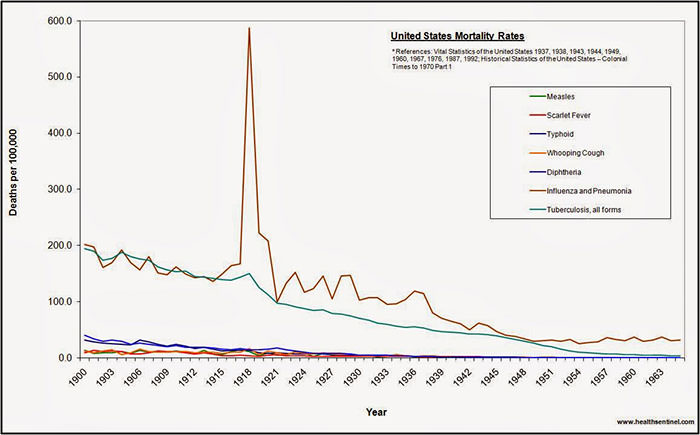
The still growing COVID-19 pandemic has reminded me of a question I've batted in my head a few times. In 1918 and 1919 a global influenza pandemic killed on the order of 50 million people worldwide. The scale of the jump in flu deaths in the U.S. can be seen in the below plot. That's more than the number of civilians and military personnel estimated to have been killed during World War I. Yet despite this, it would seem that there has been very little impact on culture (at least the culture I am aware of).

Wednesday, February 26, 2020
MGI Deconstructs the Sequencer
At some fancy restaurants one can get a "deconstructed dish". As I understand it, as I don't frequent such restaurants, a deconstructed BLT would have the bread, bacon, lettuce and tomato each as their own individual item, but prepared in a novel way which highlights the strengths of each ingredient. When I got a preview last night of Rade Drmanac's closing AGBT talk on achieving a $100 human genome (reagents price only), that was the vision I had: Drmanac and his team have created their Tx system by deconstructing the optical high throughput sequencing-by-synthesis instrument.
Saturday, February 22, 2020
CoolMPS Revealed
Having summarized MGI's announcement they are launching into the U.S. market this spring and started digging into the performance characteristics of MGI's instrument lineup, let us now turn to their BioRxiv pre-print on the CoolMPS chemistry, as it has many useful technical details.
MGI Dual Drop of CoolMPS News Ahead of AGBT
Friday morning I got excited because a preprint showed up at BioRxiv detailing the CoolMPS sequencing technology from MGI (aka BGI aka Complete Genomics). First announced in Fall 2018, this approach sounded, well, cool. Using fluorescently labeled antibodies specific to each reversible terminator seemed like a crazy pipe dream. So getting a good look at it in a manuscript is an event! But then Friday afternoon MGI had a second big pre-AGBT reveal: launch of their sequencing systems in the U.S. later this year. Below is a quick run-down of the sequencer announcement; the pre-print has many details I'm still parsing.
Thursday, February 20, 2020
A Lazy Look at The Field of Sequencing Startups
AGBT looms ahead of me next week which serves as impetus to let fly an idea I've had simmering for a while: to look at sequencing startups by a particular type of information they choose to reveal. I'm not expecting any big announcements at AGBT from this space, though would be thrilled to be surprised. But there is the risk of getting contaminated with some on-the-sly scuttlebutt, so better to get this done now. By the way, in the full disclosure category, I have consulted for a few companies here and have NDAs either on my own or via employers; everything here is based on public information.
Tuesday, February 18, 2020
Skimming Seq
My last post discussed BioJulia in the face of a challenge from the new Seq programming language. Tonight I'm going to take a bit more of a look at Seq itself and touch on both why I'm tempted to try it and why I remain reticent to do so. I hope if any of the Seq team sees this they will regard it as some parts constructive criticism and some parts market feedback.
Thursday, February 13, 2020
A Short Master Class in Benchmarking
There's a blog post on BioJulia.net that is well worth reading, even if you don't use Julia or I'd argue if you don't actually program. It looks at an issue of performance that was raised with BioJulia and with fierce but respectful passion examines the critique and explores just why BioJulia didn't perform well in the comparison. In the end, this triggers a code review and a huge speed increase in the problematic areas -- which will widely benefit BioJulia users.
Tuesday, February 11, 2020
Sampling Current & Future Directions in PCR Diagnostics
My qPCR explainer seems to have done relatively well, though it took some refinement after readers caught a number of errors. The most embarrassing of those is that I got my PCR ramp units upside down, so instead of 4 seconds or so per degree C it's degrees C per second so my times were off by a factor of 16! Ouch! Despite that miscue, I'm here going to explore some of the variants on PCR that are out there, including some that are being employed searching for the newly renamed COVID-19 virus. Included here are some of my own speculations and musings, so as always remember I'm someone who thinks about these things and sometimes talks other people into running them, but I haven't set up a PCR in 8 years. Also, the field of PCR variations for diagnostics is enormous and I don't claim to have anything near complete knowledge of it, so this should be seen as a sampler and not a comprehensive review. Also, the usual reminder I am a paid consultant for a diagnostics company but they are neither aiming at viruses nor using PCR, so I won't discuss them -- but if you feel that shifts your priors on how I treat other companies you have the information to do so.
Saturday, February 01, 2020
A qPCR (aka RT-PCR aka rRT-PCR) Explainer
I've gotten in a number of Twitter threads and seen a lot of Quora questions about the qPCR test for the Wuhan coronavirus that I realized would really be best handled by writing an explainer. I'm intending it for financial types, reporters and anyone from the lay public interested in learning a bit more. For most regular readers of this blog, there won't be anything new to you. If you'd check me for accuracy, I'd be grateful but perhaps many will skip over this one. That also means I going to try to resist my usual urges to make lighthearted references to popular culture; they're a good way to be confusing.
Thursday, January 30, 2020
Can ONT Maintain Grip on Burgeoning Flowcell Herd?
A notion dawned on me when I was mentally planning my write-up of the Nanopore Community Meeting, but I decided to put off fleshing it out until a later date. After a bit of procrastination plus a crush of other ideas, here it is: Oxford Nanopore flowcell lineup has been a bit complicated for a while, but it's probably going to get worse. There's always been serious issues with the current level of complexity and it's hard to believe this will do anything but escalate.
Monday, January 27, 2020
An Ultimately Tufnellian Look At Oxford Nanopore R10.0 Homopolymer Performance
Homopolymeric sequences have never been easy for any sequencing platform, but single molecule sequencers struggle the most with this. Oxford Nanopore has made remarkable strides in both raw an consensus accuracy via chemistry and software improvements, but still is challenged by systematic problems with homopolymers. The R10 series of pores is intended to significantly improve performance by having a longer narrow region to interact with more bases, and at the Nanopore Community Meeting there were several slides touting improved performance. Nanopore's slides have an X-axis that goes to 8. By happy circumstance, around that time we generated a large dataset on R10 and got results very similar to ONT's. Plus there's a dataset available from Mads Albertsen's group to support their updated pre-print on using Unique Molecular Identifiers (UMIs) to generate high quality consensus sequences. But our internal dataset is the best, as ours goes to eleven!
Sunday, January 26, 2020
UST Bets on TELL-Seq
I've made a few references recently to TELL-Seq, both in my flawed analysis of BioNano Genomics (I missed a key business development in their raising $18M in October; I stand by the science comments and fear that the fund raise buys them about a year of time) and on 10X Genomics discontinuing their genome assay kits. Now to actually dig into that technology -- a bit late given the preprint came out last fall, but better late than never. So put on your sunglasses and hoodies, conjure up the image of early television chefs and key up the theme music for The Lone Ranger, because here I go.
Thursday, January 23, 2020
Can BioNano Genomics Map A Way Past Twin Perils?
When playing with the structure of this piece in my mind, it occurred to me that Norman Maclean's thoughts about fly fishing apply just as well to biotechnology companies
It is also interesting that thoughts about fishing are often carried on in dialogue form where Hope and Fear -- or, many times, two Fears -- try to outweigh each otherThe executive team at BioNano Genomics may well be gripped by this situation, as they are faced with two great perils: their finances and their markets.
Wednesday, January 22, 2020
Genia: It's Alive!
Once in a while I get the thrill of someone sending me a really good tip - that surge that comes with knowing that I know something that most people don't. That rush of knowing that soon I'll get to spill the beans. It's great, even if it upends my widely disseminated opinions. Even if a moment later I realize that if I had thought harder I would have unearthed the nugget on my own. All of which is the case here -- my tea leaf reading that Roche partnering with Illumina on diagnostics indicated that Genia is no more -- well, that interpretation is no more. Because I got a hot and verifiable tip that Genia is very much still an active project at Roche. And the verification is how I could I found this independently.
Sunday, January 19, 2020
10X Genomics Exits Genomes
10X Genomics original product was a kit for generating linked reads from genomic DNA. The idea had been kicking around for a while, partitioning long DNA into compartments and generating tagged libraries from each compartment. This enabled both genome assembly and haplotyping from very small amounts of DNA. When first reviewing 10X's slides from J.P. Morgan I had this thought "where's the genome kits" but then forgot to include it in my write-up. Now I'm even more chagrined to discover that the explanation had been posted days before the conference: 10X has told their customers that their genome library kits are in the process of being discontinued.
Friday, January 17, 2020
JPM20 Loose Ends: Agilent, ThermoFisher, 10X Genomics, NanoString - plus PacBio & ONT
Time to close out J.P. Morgan season with a grab bag of kvetches and kibbitzing on multiple 'omics companies that presented. Much of this has been stimulated by Twitter discussions, with particular credit going to Varro Analytics and Albert Vilella. While I've never been to J.P. Morgan physically and am skeptical I'll ever go, reviewing all this is a great prep for AGBT -- which I'm happy to be returning to this year for it's last Marco Island appearance for many years (forever?).
Tuesday, January 14, 2020
Bold Genapsys Talk at JPM20
Genapsys' CEO Hesaam Esfandyarpour presented today at the JPM Morgan Conference and delivered an expansive vision of where the company is going both this year an the long term. This includes planned commercial launch of the 144M chip this year, an aggressive expansion into international markets and another round of "pre-IPO" financing.
Monday, January 13, 2020
JPM20: Roche Links with Illumina On Diagnostics
Another bit of Illumina news released at J.P. Morgan today is that Roche Diagnostics is partnering with Illumina. The 15 year partnership (same duration as with QIAGEN) will place Roche diagnostic assays on Illumina clinical-grade sequencers as well as the two will jointly work for regulatory approval of Illumina's TruSight Oncology assays. Roche has extensive experience in oncology, particularly since they own Foundation Medicine. This suggests that Roche is happy with a two pronged strategy in oncology diagnostics, selling assays on their own through the partnership while their Foundation arm offers an all-in service. But it also stirs the tea leaves in the genomics M&A pot.
JPM20: Illumina Launches Super Resolution Instruments
Illumina presented this morning at the J.P. Morgan Healthcare Conference (presentation, slides & breakout). For us sequencing geeks, the biggest news is the launch of a pair of new sequencers -- but not where either myself or Shawn Baker anticipated. Rather than doing something about the low end of their line (as I predicted) or replacing the MiSeq as Shawn guessed, Illumina perceived a need for desktop instruments to span the range between the existing NextSeq 550 and the NovaSeq and has christened the new instruments NextSeq 1000 and NextSeq 2000. They also come with some slick new technologies embedded.
Sunday, January 12, 2020
Is Illumina Vulnerable At The Bottom?
According to both the FTC and CMA, Illumina holds a nearly complete monopoly on the sequencing market, with other players (Ion Torrent, Oxford Nanopore) holding on to toehold niches. Illumina has held that position for an extended period, so what might upset it? I'm going to explore the case that they may have some serious inroads at the bottom of their line.
Thursday, January 09, 2020
Might Illumina Shave NovaSeq Run Times?
I've had some people asking, either privately or via Twitter, what might come from Illumina next week at JP Morgan (8:30 am PST on Monday). I have another post in the works (ideally going out not long after this one) on one aspect of their business, but then I thought of something else. Something in the great tradition of proposing a plan while being quite unaware of all the critical details that the plan relies on!
Sunday, January 05, 2020
A Le Mans for Clinical Genomics?
If you haven't seen Ford v Ferrari (or Le Mans '66 in parts of Europe), I strongly suggest you do so if it is still in a local theater. I'm neither a gearhead nor a fan of watching automobile races, but while the movie is centered on an attempt to win the 1966 24 Hours at Le Mans, there is so much more going on. Designer Carroll Shelby (Matt Damon) must not only project manage a difficult task, but also deal with unreliable allies (as one wag put it, the biggest villain in the title isn't Ferrari) and a cantankerous star driver named Ken Miles (Christian Bale). One touching aspect of the movie is the portrayal of Miles' relationship with his young son, an audience proxy who idolizes but sees all sides of his father.
Thursday, January 02, 2020
Illumina & PacBio Throw In The Towel
I had planned to post this morning a "preview of 2020" piece I had drafted in my head on the ski slopes the previous two days, but never got around to actually committing it to bits and bytes. Today's announcement that the Pacific Biosciences acquisition from Illumina is officially dead means the first item of that piece is mostly going uncaptured.
Thursday, December 26, 2019
Long Overdue and Overly Short Notes on Clive's NCM 2019 Talk
A theme of the 2019 Nanopore Community Meeting in New York was the long and short of nanopore sequencing. While the public sparring with Illumina/PacBio over the definitions of sequencing types wasn't explicitly discussed, certainly ONT wants to make sure that people understand they don't intend to ignore applications that are naturally short reads. I've been slowly trying to get this summary to gel for awhile, with the usual distractions this time of year of some trips, planning for holidays and a bout with a virus. Plus general procrastination.
I'm just going to cover Clive's talk; there were some really spectacular presentations (including one by someone who remarked that they hoped their upcoming thesis committee meeting would go well! One of multiple excellent platform talks by very junior scientists) If you'd like to watch yourself, the video of Clive's talk is online. Watching it again is kind of fun, except for the distraction of seeing a guy with huge glasses trying to live tweet from the front row. I've put in brackets rough timepoints for some of the topics; you may need to slide back or forth a bit to nail it exactly but they can land you near the right spot.
Monday, December 23, 2019
Merger Questions to Mull Over Your Cider
With the full FTC complaint against the Illumina-PacBio merger now out in the open but the holiday break bearing down like a reindeer on steroids, I want to leave you with a few questions to ponder over your wassail. Because what holiday gathering is not enlightened by discussion on the Herfindahl-Hirschmann Index (HHI)?
Wednesday, December 18, 2019
FTC Slams Illumina-PacBio Merger, but Illumina Not Quitting Yet
Tonight I was intending to finally get out my summary of technical notes from the Oxford Nanopore Community Meeting, but yesterday the U.S. Federal Trade Commission issued a press release that they believe the proposed acquisition of Pacific Biosciences by Illumina would be grossly anticompetitive and cannot be approved in any form. A more detailed report is promised but hasn't surfaced yet. Curiously, not only did this ultimately move PacBio's stock very little, but today Illumina and Pacific Biosciences filed matching SEC documents that Illumina will continue to infuse cash into PacBio through March of next year. Also, I should note that someone left a passionate defense of regulators in the comments on a prior piece, noting that the FTC decision shows that the CMA was justified in opposing the deal and not simply acting with a parochial eye on Oxford Nanopore.
Tuesday, December 10, 2019
Is ONT Really Going to Twist the Watch Stem Backwards?
I was in New York last week for the Nanopore Community Meeting. I'll save some technical updates for tomorrow, for I wanted to focus today on a huge inflection point that Oxford Nanopore announced that they will really will punch through next year. I'm going to do that with an extended comparison to Robert Bloch's wonderful short story That Hellbound Train. I won't spoil that story, but if you want to first go find a copy to read (there is apparently now a graphic novel version) or spend a half hour on a decent narration of it, please do. It's especially a joy if you're steeped in the lore of American railroading.
Thursday, November 21, 2019
Should Patent Pool Save the ILMN-PACB Merger? ONT Doesn't Think So
Last week the UK’s CMA published a proposal submitted by Illumina and PacBio to save their merger. This was then published in a revised, seemingly more generous form on Wednesday. Most strikingly, the proposal tackles head-on an elephant long in the room: is the CMA playing hardball because the biggest competitor in this space is not named Oslo Nanopore Technologies.
Wednesday, November 20, 2019
Genapsys Launches
Today Genapsys launches their sequencer into the U.S. market, with worldwide launch next year. They also received a new round ($90M) of financing from a major firm, Foresite Capital. In addition to the Press Release and Media Kit, Genapsys' PR team, provided me with answers to a set of questions I provided. As a reminder, I previously covered their pre-print pushed out to BioRxiv six months ago.
Thursday, October 24, 2019
CMA Drops the (Preliminary) Hammer on ILMN-PacBio
Today the United Kingdom's Competition and Merger Authority (CMA) issued their preliminary report on the proposed acquisition of Pacific Biosciences by Illumina. The report has no dry British phrasing: they clearly state that the merger is anticompetitive and that the only legal remedy is to block the transaction. Interestingly, today was also the scheduled Illumina Q3 earnings call, but the subject wasn't even broached there.
Monday, October 21, 2019
QIAGEN Quashes GeneReader
Two weeks ago QIAGEN announced they will discontinue development of their GeneReader short read instrument and move their portfolio of gene panel tests over to the Illumina MiSeq and NextSeq. Existing instrument owners will continue to be supported for an indefinite period. Thus ends QIAGEN's effort to build a fully vertically integrated sample-to-answer diagnostic sequencing system, just short of 4 years from the system's launch. What can be learned from this and how does this reshape the sequencing market?
Thursday, September 26, 2019
Illumina Throws PacBio An Extension and a Lifeline
Interesting news today on the PacBio front: as reported by GenomeWeb, Illumina announced that their walkaway date for the acquisition has been extended to March 31 of next year and that Illumina will be pumping significant cash into PacBio until either the merger occurs or is terminated. In addition to publicly reinforcing Illumina's determination to get the deal done, the terms of the arrangement have interesting consequences should the deal fall through
Where U.K.'s CMA Missed the Plot
I've written far more than I expected to on the PacBio merger, with it dominating my output here this summer save that recent dip in the CCS boomerangs. We still haven't heard from the U.S. FTC, which is the big hammer that could drop and the stock is still selling at a substantial discount to the price offered by Illumina. While I've hinted at it, I've never quite detailed my major objection to the form of the UK CMA's analysis of the proposed acquisition. I've missed the opportunity to lay that out during the period of public comment for the next round of the CMA. Still, worth it to write it down. Which was true about a month ago when I wrote this, then failed to actually push it to a post before I headed out for a rugged vacation in the American West. And then forgot about it after returning. And more news today to comment on -- so better finally get this out there.
Thursday, September 19, 2019
Amazon Needs Another Training Track
I spent a day recently taking Amazon's "AWS Technical Essentials" course. I had originally opted not to go, but a summons went out that we had already paid for seats and that everyone using AWS should really go. I've been in far worse courses and certainly had no complaints with our instructor, a former mechanical engineer who knew his stuff and was never in salesman mode. Indeed, many of the tips I extracted had to do with how to save money. No, the problem is that the course is designed for a very, very different use case than anyone in my shoes is interested in. It's a use case that I'm sure Amazon has a few bazillion customers for, but I'm just not one of them.
Friday, August 23, 2019
Mirror, Mirror Have You Leads, On My Strange HiFi Reads?
A core purpose of this space is to explore the current state of genomics technology. Much of the time this is via distilling news reports, press releases and interviews with persons in the field. But even more fun is to dive into actual data. Such data is often accessed via the generosity of researchers who deposit open access datasets. But it is also true that part of my professional responsibilities is to determine when new technologies and methods have applications at my day job, so I'm also charged in the day job with contemplating experiments to plumb sequencing systems. Only by doing so can we ensure that we maximize our ability to perform cutting-edge synthetic biology. A recent such experiment generated some curious data which I have obtained permission to share a subset of it publicly, as I'm scratching my head and hope that someone out in the community has insight.
Sunday, August 11, 2019
Wall Street Bets Illumina Won't Acquire PacBio
The proposed PacBio-ILMN Merger remains an interesting spectator sport, with the UK's CMA looking for public input for the next round. I don't usually pay attention to stock prices, but PacBio's current state presents too juicy a situations. Just to be clear though: I do not hold any individual stock position in PacBio or Illumina (the bulk of my investing is in broad mutual funds, some of which certainly have bits of these companies).
Wednesday, July 24, 2019
UK CMA & ILMN/PACB: The Inconvenience of Being Earnest.
As part two of a yet-to-be-determined number of pieces on the UK's CMA preliminary analysis of the proposed Pacific Biosciences acquisition by Illumina, I'd like to briefly explore the surprising authority of this agency to plumb internal documents at the two companies.
Sunday, July 21, 2019
UK CMA's Write-up of PacBio Acquisition by Illumina Makes for XXX Reading; Clearly They Believe XXX and XXX
After writing my two recent pieces on the business side of the long read industry I planned, after a recent extended family vacation, to try to get back to science. Particularly after my chagrin when various correspondents pointed out a fact from each I should have found and didn't: in my ONT piece I failed to discover that ONT has two share classes and the Woodford fund's shares cannot be used to gain control of the company and in the PacBio piece that there is a $100M breakup fee due PacBio if for any reason the deal doesn't go thru. I'm particularly red faced on that one, as a breakup fee would play importantly into PacBio's financial health should the deal go south; $100M would buy perhaps two quarters time.
But then a bunch of people threw my way the UK Competition and Mergers Authority (CMA) report on the merger and I foolishly opened the document. It makes for interesting reading, but that is hampered by the fact it is highly redacted -- like my title. Reserving the right to comment on the contents substance at a future date (or never), I'd just like to give a tour around some of the redactions.
Monday, July 01, 2019
Will Regulators Scotch PacBio Acquisition?
When Illumina announced its proposed acquisition of Pacific Biosciences last fall, an immediate question arose as to whether the deal would pass antitrust review. Illumina must have been optimistic, as they originally expected the deal to close in "mid-2019". That timetable has now been rolled back to late 2019 in the face of the UK agency with jurisdiction over mergers deciding to go for a second round of review and no word yet from the U.S.'s Federal Trade Commission.
Tuesday, June 18, 2019
ONT & The Woodford Liquidity Squeeze
There's an unfortunate chain of events that may end up causing a headache for Oxford Nanopore, and it's completely outside their control. One of the their key investors has just had his luck - or perhaps more critically his reputation -- at stock picking disintegrate. Because of some unusual choices, that has potential repercussions for ONT.
Thursday, May 30, 2019
The Genius of Plongle
I noted in my roundup of Oxford Nanopore technical announcements that I loved the Plongle concept. This is really both a new application-specific integrated circuit (ASIC) and using it to build a 96-well sequencer. Let me expand on what there is to love.
ONT's Horrid Data Storage Folly
In the coverage of ONT's announcements at London Calling, I specifically left out one of Clive's Skunk Works projects. This would be a device to use nanopores to write digital information. I'll give him points for creativity, but the reason I held this for here is I truly and sincerely hate the concept and didn't want my vitriol to distract within the other piece. But here I will let loose.
Wednesday, May 29, 2019
ONT's London Calling Announcements, Pass One
The annual big Clive Brown London Calling talk had a twist this year Brown introduced a set of senior lieutenants at Oxford Nanopore and then tacked on a few "and one more thing" moments at the end. If you're looking for the TL;DR version from me, it is that there were a lot of sensible but non-Earth shattering updates from the team followed by Clive updating on one prior crazy idea and throwing out two more -- one of which I love and the other I believe should be thrown out posthaste.
Thursday, May 23, 2019
Nanopore's Long DNA Paradox
The first half day of London Calling has already delivered the usual mix of scientific excitement. The prospect of lives, particularly those of children, en masse by delivering precision oncology broadly across sub-Saharan Africa. Dizzying levels of alternative splicing in a key brain ion channel. RNA modifications in great numbers. That one was also gratifying as it was commented that even without a basecaller, modified bases can be be suggested by higher error rates around a particular motif. Around 2015 or so I noted in the Nanopore Community post that error rates went up around GATC sites in E.coli, the target of Dam methylase. Protein tags read by the current nanopore scheme. Tonight we get Clive and company performing their usual razzle-dazzle of product announcements; one person pointed out to me a possible angle I failed to include in my laundry list is the raising of the speed limit from 450 to perhaps 1000 bases per second. But another omission was front-and-center in the plant genomics sub-session I attended and could be called the central paradox of the current state of nanopore sequencing: pores are great for long DNA but long DNA is not great for pores.
Tuesday, May 21, 2019
Care to Pore Over My Laundry List?
London Calling is this week, so get ready for lots of Oxford Nanopore in my Twitter channel and if I'm on the ball, in this space. ONT has made a number of releases and updates and there have been other developments within the nanopore ecosystem which I've failed to report. Here, in not terribly organized fashion, is a laundry list of things I'm thinking about going into the meeting
Monday, May 20, 2019
Mass Recoded E.coli Genome Not Tripped Up By Programmed Frameshifts
There's a paper this week in Nature announcing an E.coli genome which has had two serine codons (UCA, UCG) and one stop codon (UAG) removed from usage. It's a major work on synthetic biology and represents the largest designed sequence ever built. In contrast to Craig Venter's early effort, which moved a synthesized genome into a cellular ghost of a natural bacterium, this one replaced the native E.coli genome in stages -- Escherichia theseusshipii would be a good name for the new strain. But is the genome quite what is advertised? Following up on a pair posts from Sandeep Chakraborty showing remaining UCA, UCG codons and UAG codons in a bunch of typical genes, I decided to look for a trickier set of possibilities to overloop -- and by luck or care the Nature paper got these. Just to put one gripe front-and-center, the group deposited in Genbank the reduced genome version of E.coli they started with, but not the recoded genome, which is in the supplementary material
Friday, May 17, 2019
My Career's Double Slit Experiment (or, A Funny Thing Happened on the Way to the Drydock)
When I announced recently that I had moved over to Ginkgo Bioworks, I was compelled to leave out an important part of that story. Indeed, by just focusing on the (still open) position of NGS Head, I could avoid the sticky subject of how exactly I ended up there. Today the press release finally went out and the fact that Warp Drive's genome mining business is now owned by Ginkgo is public (covered nicely by Amy Feldman in Forbes). But in the spirit of my periodic public coverage of my own journey, here is some of the rest of the story.
Monday, May 06, 2019
Genapsys' Base Caller: Mysterious, But Not Ideal?
When I wrote about Genapsys' pre-print on their sequencing system the other night, I intended that to be the last I wrote until some major news from them. But after launching that into the great Internet ether, I found myself lying awake wondering if a very simple idea had any merit. Painfully simple -- I almost didn't pursue it because it was so simple and obvious. But, it turns out it appears to have merit -- there may be an obvious route to improving the accuracy of Genapsys' basecalling on homopolymers. And that also took me into ground I've thought about before -- going back to my first year at Codon Devices over a decade ago -- on the challenge of modeling sequence quality.
Thursday, May 02, 2019
Poking at Genapsys Preprint
Genapsys is continuing down the path of pre-launch information, most recently releasing a pre-print. I'm looking at this pre-print critically and unfortunately turning into a bit of Reviewer #3. Not that anything is fatal and pre-publication review is a key value to pre-prints. If I were an actual reviewer I'd be writing mostly the same things and covering more vertebrate species than they sequenced (a human exome panel was included, though most samples were bacterial) -- I'd grouse about a missing figure (which I've provided), carp about critical details not provided and beef over a public data deposit that doesn't really line up with the unqualified claim made in the paper. (*)
Wednesday, April 24, 2019
Want to Run An Exciting Sequencing Group? Ginkgo Is Looking for You!
I've awakened from my blogging torpor to point out a really interesting career opportunity for the types who might read this space. Ginkgo Bioworks, one of the leading synthetic biology companies in the world, is looking for someone to run their existing Next Generation Sequencing group. It's a chance to run an energetic high-throughput sequencing group that works on a wide range of projects. And, as you might of guessed from the fact I'm writing about it here, you'd also get to be my boss. I'm hoping many will see that as a feature and not a bug.
Monday, March 25, 2019
Nanosens Publishes Proof-of-Concept for Point-of-Care CNV Diagnostic
Here's a killer technological challenge for anyone: design a scheme to detect vanishingly small concentrations of a valuable analyte in a biological fluid. The assay must require zero pipetting, work in the field at ambient temperature, generate results quickly, contain positive and negative controls, be usefully precise and accurate, and be usable by personnel with no formal technical training. Oh, and be dirt cheap as well.
Wednesday, February 20, 2019
Beyond Generations: My Vocabulary for Sequencing Tech
Many writers have attempted to divide Next Generation Sequencing into Second Generation Sequencing and Third Generation Sequencing. Personally, I think it isn't helpful and just confuses matters. I'm not the biggest fan of Next Generation Sequencing (NGS) to start with, as like "post-modern architecture" (or heck, "modern architecture") it isn't future-proofed. Not that I wouldn't take a job with NGS in the title, but still not a favorite. High Throughput Sequencing feels a little better, but again doesn't leave room for distinguishing growth -- and HTS as an abbreviation is already going to confuse anyone in Biopharma who thinks about High Throughput Screening. Massively Parallel Sequencing sort of works, but my late father had a real pedantic objection to using "massive" for anything that lacked mass, and while I don't subscribe to that view such uses just don't sit well with me. Worse, as I'll explain, trying to divide sequencer technologies into Second and Third generations creates more heat and smoke than light. On a number of Twitter threads I've tried to launch my own terminology, but probably haven't been terribly consistent. So here is an attempt at that.
Thursday, February 07, 2019
Failing to Fetch An Interesting Result on Dog Oncogene Homologs
An idea for a little exploration occurred to me back at Infinity -- that is 7.5 years ago -- that I've never tried out. But I never got around to it. I had some downtime recently to play around so I finally executed the experiment -- alas, it turns out not to be very interesting. Still, a negative result is a negative result.
Wednesday, January 30, 2019
Covaris Grabs A Spot on the Liquid Handler Deck
For as long as I can remember, Covaris has been the standard in DNA shearing for high throughput short read sequencing. Their benchtop units had their quirks -- custom tubes being the foremost -- but they were what everyone else compared to. In 2013 when the American Society for Human Genetics was in town, the PacBio folks did me a great favor and loaned me an exhibit hall pass. Multiple companies were offering DNA shearing instruments -- and every one compared themselves against Covaris. Now they have a new offering, moving the instrument onto a liquid handling robot deck so that it is available for high-throughput workflows. Covaris invited me down to their Woburn, Massachusetts facility to get a look at the instrument before its formal launch at the SLAS conference
Tuesday, January 29, 2019
Patent Dive: Genapsys
Here's a dangerous statement for me: I actually enjoyed reading some patents recently. Now, before you get any ideas in your head about suggesting more patents for me to read, let me be clear that these were unusual patents -- they're written to be read! -- and were read under strict conditions. The patents in question are from Genapsys -- found via my good friend Justia.
Monday, January 28, 2019
Metabolic Whac-a-Mole
Derek Lowe summarized a really cool paper back in October. I've been meaning to grab a copy, but discovered recently that the MIT library no longer has an easy way for outsiders to slip in an use their subscriptions. So I'm working off his summary, but since this is mostly an excuse for flights of genetic fantasy actually reading the paper would probably just hinder me!
Friday, January 25, 2019
2019 Tech Speculations: Oxford Nanopore
As promised in the last post, I'm segregating out Oxford Nanopore. Admittedly I tend to cover them relatively closely -- though I never seem to quite finish writing up their conferences -- but at the moment ONT is the only major player in the U.S. research sequencing market not being run out of (or about to be run out of) Illumina HQ. And I'll be very to the point: ONT has a lot of balls in the air and irons in the fire, but from my point-of-view what matters most is rapid and regular progress on the accuracy front.
Tuesday, January 15, 2019
2019 Sequencing Tech Speculations: Will We Actually See New Entrants?
An astute reader caught a sentence fragment about MGI in last night's Illumina JPM roundup -- the unfortunate evidence of a a mental battle over whether to put any further comments on MGI in an Illumina-centric post. So now I'll sweep that bit into a general post about not-Illumina (and not-Oxford, that will go in yet another).
Monday, January 14, 2019
Illumina JPM Talk
Illumina CEO Francis deSouza delivered his J.P. Morgan Healthcare Conference talk (webcast audio, slides & Q&A audio) a week ago. I can claim that some of my speculations came true -- just the most boring and obvious ones. Overall, the presentation was the talk of a confident market leader.
Sunday, January 06, 2019
2019 Sequencing Tech Speculations, Part I: Illumina & MGI
Next week is the J.P. Morgan Healthcare Conference. It's striking this year the paucity of companies in the genomics space -- Illumina on Mondayat 6:00 EST and MGI on Wednesday at 5:30 EST and Nanostring at 6:30 EST on Wednesday. Perhaps NVIDIA will say something interesting about their forays into healthcare, such as providing the chops for real time nanopore basecalling, on Thursday at 11:30 EST. There's also some nice polls from Albert Viella on Twitter
So, before all the beans are spilled, here's some of the speculations and ponderings I've been entertaining about the sequencing technology field for 2019 for Illumina and MGI. I'll cover some of the other players in the next few days, but since Illumina is up on Monday that's the priority!
— Albert Vilella (@AlbertVilella) January 5, 2019and some more Twitter speculation
Predictions for @Illumina #JPM2019. Besides PacBio news, expecting NovaSeq SP 2x250. Any longer S4 kit or potential S5 would require upgraded onboard storage. Really hoping no new NovaSeq system.— CAT at UCSF (@CAT_UCSF) January 4, 2019
So, before all the beans are spilled, here's some of the speculations and ponderings I've been entertaining about the sequencing technology field for 2019 for Illumina and MGI. I'll cover some of the other players in the next few days, but since Illumina is up on Monday that's the priority!
Thursday, January 03, 2019
2019 Resolutions
2019 is upon us; I'm hoping it will be a bit less eventful than 2018. It wasn't all bad -- I took two trips that delivered scenery I have only right to see once in a lifetime -- but it was essentially bookended by losing my father and a revolution in my workplace. Mixed in there is the bittersweet pride of seeing one's offspring graduate from high school and proceed on to college.
New Year's resolutions are notoriously difficult to keep -- one is fighting entrenched behaviors -- but bringing in some external pressure might help. So I'll make my two resolutions for the year very public: that I post here more regularly and that I read more non-fiction books to the end. And the hope is that you, dear reader, if you meet me, feel free to pointedly inquire about my adherence. Or hit me via Twitter!
Thursday, December 13, 2018
An Unfortunate Master Class in Poor Plotting
I hope my admiration for Pacific Biosciences intellectual acumen was clear in my post on the acquisition by Illumina, because now I'm going to be a rabid crab over a webinar they aired yesterday. I take telling scientific stories seriously and an important part of telling such stories is displaying data well. I'm a perfectionist in this department by intention, but not always by execution -- I'm constantly reanalyzing my plots and diagrams for errors and cringing when I find them. The webinar is trying to extol the value of the latest developments in the SMRT platform, but the data graphs often actively fight against any understanding or excitement.
Wednesday, December 12, 2018
Flappie vs. Albacore via Counterr
I'm going to go through some analysis of Oxford Nanopore basecalling, running some quick comparisons using a freely-available tool called counterr which was announced at the Nanopore Community Meeting two weeks ago. Counterr was developed by Day Zero Diagnostics, a startup I advise -- though in announcing yet again my COI I will stress I don't get paid to help give away software! This is just a small bit of analysis; nothing as comprehensive as Ryan Wick's ongoing analysis with a ready-to-submit preprint masquerading as a README file.
Thursday, November 29, 2018
Nanopore Community Meeting 2018: The Clive Report
Given it's late and I just dashed through a classic San Francisco downpour, I'm going to mostly stick to covering Clive Brown's talk tonight. Within it there were a number of announcements, and for anyone following this space I get to point out things I've proposed in the past that are moving to fruition as well as recent statements I made that were quite erroneous.
Also note that tweets during his talk have been collected by ONT into a Twitter Moment
Also note that tweets during his talk have been collected by ONT into a Twitter Moment
Wednesday, November 28, 2018
A Few Things Before Nanopore Community Meeting Begins
Nanopore Community Meeting begins within the hour. San Francisco is spectacular as ever -- Alcatraz Island disappearing into the fog as I fiddled with camera settings, the spectacular Bay Bridge spans are visible from the the breakfast area and I even got to see some notable locals on my walk over from the hotel
If this crowd doesn’t get a move on, they’re going to miss #nanoporeconf breakfast pic.twitter.com/rFwfGdQTit— Keith Robison (@OmicsOmicsBlog) November 28, 2018
Hans Jansen was kind enough to remind me by tweet of a couple of missed topics in my preview piece. So let's cover them!.
Tuesday, November 27, 2018
Nanopore Community Meeting 2018 Preview
Okay, now that I'm done venting -- for now -- about ONT's customer service experience (well, almost done -- they sent me the same damn letter they sent my colleague -- why were they several hours apart???) -- let's move on to the Nanopore Community Meeting. Technically it started today with the training session, but I'm not heading out until tonight. At the first one of these in NYC Oxford tried to avoid making any announcements, but they seem to now like having two major focus times a year sometimes supplemented with Clive Brown webinars in between. Here are some
How Not Do Think Like A Customer: Examples from ONT and AMZN
I'd planned today to use some downtime to write up a preview of the Nanopore Community Meeting which I am attending tomorrow and Thursday. I might still do that, but the same organization just engaged in the sort of customer engagement that drives me batty (yeah, twisting the lion's tail before entering their den -- smart move or what?) and it reminded me of another lousy experience I had recently with a very prominent company: Amazon.
Thursday, November 15, 2018
Failure: The Real Secret Sauce of Engineering
I took one swing at Vijay Pande's overly rosy piece on applying engineering methods to biology and medicine and similar minded efforts were published by Ash Jogalekar at Curious Wavefunction and Derek Lowe at In The Pipeline. Perhaps I shouldn't make another go, but it is a new excuse to explore an old fascination of mine. Pande's subhead was "Billion-dollar bridges rarely fail -- whereas billion-dollar drug failures are routine". I can't argue that. Actually, it would seem from an informal search that billion dollar bridges are actually much rarer than billion dollar drug development programs. Obviously they exist -- I've traversed the new Tappan Zee Bridge which came in over $3B. On the other hand, a second crossing at perhaps the most notorious spot in bridge engineering history, the Tacoma Narrows, was built earlier in this century for only $0.8B. What I wish to explore are the failures of bridges and other structures of any cost, as it is the analysis of failures that frequently propels engineering forwards. That analysis is enabled by the relative simplicity of human engineering and the artifacts it uses and creates. Conversely, analyzing the failure of new drugs is nothing like that.
Thursday, November 08, 2018
No, the Groves Fallacy Can't be Retired Yet
Vijay Pande has a thought-provoking piece in Scientific American on the Groves Fallacy, though in the end I'm afraid mostly what he provokes in me is the thought that he's in most cases pretty far off base. Titled "How to Engineer Biology", he claims that the Grove Fallacy -- the idea that biology can't be tamed by engineering -- is quickly being put to rest. And Pande isn't some naive Silicon Valley type, but a professor at Stanford whose lab works in experimental biology. So he has some street cred -- but that doesn't mean he isn't mostly wrong.
Monday, November 05, 2018
Illumina Buys PacBio: More Thoughts
Illumina surprised pretty much everyone in the genomics community by announcing the purchase of Pacific Biosciences. I had spent Thursday deep in the weeds of a combined PacBio-ONT-Illumina dataset, so was caught completely by surprise on my commute home by an email asking for my comment. If you do want to hear hot takes on it from myself and AllSeq's Shawn Baker, Theral Timpson over at Mendelspod interviewed us that night. There has of course been much discussion of the deal and tributes. I've had the weekend to ponder things, and here are some somewhat better thought out and detailed comments -- though I don't believe I've retreated from any of the themes in the podcast. I've grouped the thoughts into a few themes.
Tuesday, October 16, 2018
You Can Be Impatient Running MInIONs, But Not Feeding Them
Yes, it's been way too long since I wrote here. Even longer since I did so with any regularity. There was always some list of things draining my time and energy. But I resolved this week to get back on the horse -- and that was even before today's bit of dilithium news. In particular, in one twenty-four hour span three different people remarked on the prolonged hiatus -- a professional contact, a commenter on the blog and finally some very cutting remarks from Draco (aka TNG). And what better way to get going again but to kvetch about Oxford Nanopore's supply chain model?
Tuesday, July 31, 2018
Two Museums Guaranteed to Fluor You
I've been horribly neglecting this space for an extended period. Contributors to that include a TNG eclosing from high school, ferrying grandparents, a milestone (or is it millstone?) birthday and a 10 day vacation with poor Internet service. Oh yeah, another one of those starts Thursday. Then there's keeping the genome factory going -- at times I feel like a worker in Fritz Lang's Metropolis. But someone even noticed and emailed me today whether this hiatus would end, which is beyond reason enough to get going. But tonight's entry has nothing really to do with biology or genomics, but rather hearkens back to the first science I fell for.
Subscribe to:
Posts (Atom)