I realized a few Oxford Nanopore announcements too late that I should have tried to log all their predictions with a date made so I could track carefully any delays or quiet disappearances from the new feature lineup. If I had done that, this year would have presented an even worse conundrum: how do you score progress in a year of constant disruptions? Like many companies in the sequencing field, at least some of that disruption has been a diversion of attention and resources to fighting the pandemic. For ONT that is largely supporting the ARTIC viral genome sequencing and also developing LamPORE diagnostics.
Friday, December 18, 2020


Sunday, December 13, 2020
BGI Floats Idea of Tape-Based Sequencer
I reported on the AGBT 2020 final talk a few centuries ago -- or at least it seems like that given how quickly the world went to hell just after that -- by BGI in which Rade Drmanac showed off a system which I described as a deconstructed sequencer -- an integrated set of plate handling robots, liquid handlers and imagers which dipped the slides into reservoirs of reagents instead of flowing them through a flowcell. Now BGI has a preprint on BioRxiv which takes this idea a bit further, changing out the reagent tanks for a polymer film on which a thin layer of reagent is distributed, which is then pressed gently against the slide surface to deliver the reagent to the DNA Nanoball (DNB) array. The preprint is filled with eye-popping numbers -- Petabase sequencing!
Monday, November 30, 2020
PacBio's Renewed Energy
When confronted by antitrust regulators last year, the core thesis of Illumina and Pacific Biosciences was that PacBio could not survive as an independent company. After giving up on the merger, PacBio decided to dispute their own thesis -- and seem to be succeeding so far. As highlighted at their recent "Global Summit" meeting, they have a new CEO, new financing and a burnished product offering.
Thursday, November 19, 2020
Bioinformatics Exercise: Gene-Specific Ser Codon Usage
I saw a provocative abstract in PNAS about the usage of serine codons in E.coli that triggered the "this could make an interesting student exercise" (for my prior effort, see: Exercise: A Sequence Signature for Transcription-Translation Coupling in Bacteria?). The paper is behind a paywall (though a relatively cheap one at $10) so I haven't actually read the paper, but the purposes here that isn't really a problem -- I'm not going to critique the paper, but just use the concept as a springboard.
Saturday, November 14, 2020
Bionano Genomics: A Belated Update
Back before I can remember -- as in January of this year -- I wrote a piece on the challenging situation of BioNano Genomics. I got an important detail wrong in that piece, missing some important fundraising, but in general from the point-of-view I took I thought it was a decent piece, meant to convey the challenge of a really amazing technology having its original market disappear. Some commenters took strong exception to the piece and suggested I had not-so-pure motives for writing it. They're wrong -- but at AGBT I got a chance to learn more about the company's new direction and how I hadn't been looking at things quite appropriately. I should have written it up there, but working on a response to the pandemic started taking over my life and I let time slip away. Preparing crow to be eaten also tends to be procrastinated. But here, finally, is a re-look at the company (and, I drafted this over a month ago and never finished -- the procrastination drags on...)
I was a bit nervous strolling into the BioNano Genomics booth at Marco Island. Maybe they were the ones so offended by the piece. But no, they actually invited me to come to a morning talk and to chat afterwards, and were completely professional and cordial and made it clear they understood the angle I had taken as a sincere journalistic approach. But not only did I hear the talk then, but I had gotten a preview the night before in the Twist Suite, which also illustrates a key card BioNano has: a collaboration with Alexander Hoischen
Monday, October 12, 2020
10X Triples Down on Spatial Analysis
10X Genomics last week announced the purchase of ReadCoor, a company that unveiled its 3D spatial sequencing instrument back at AGBT, paying $350M to acquire the Cambridge MA company. This follows quickly on the heels of 10X purchasing Swedish in situ sequencing company CartaNA for another $41M. 10X already had the Visium spatial transcriptomics product on the market. So now 10X has three different technologies in the spatial profiling space.
Wednesday, September 30, 2020
Keeping an Index on a Subtle Difference in Illumina Chemistries
I like to pretend in this space that I catch all the little details of the different sequencing platforms. Well, at least over time I try to do that. But ego aside, that is often a mark not made. A bit of a year ago I discovered that there's a small difference across the Illumina family that is completely separate from how clusters are generated (Bridge Amplification randomly arrayed or Exclusion Amplification in nanowells) or the wavelengths of light used in the fluorescence microscopy (now blue on the newest NextSeqs, with superresolution microscopy coming soon) or 4 color vs. 2 color vs. 1-color (well, really staged 2-color) chemistry for the reversible terminators. There's a subtle difference in how the second index is read. I'm not spilling a deep secret: it's right out in plain sight within an Illumina technical document
Monday, August 31, 2020
Self-Assessing My Python
I've been programming 90+% in Python now for over a year and a half -- when I joined the Strain Factory I vowed to finally make the break from Perl. Partly this was disgust with so often finding libraries I wanted to be missing or broken, and partly it was recognizing that the Factory is primarily a Python shop and I would have the most impact if I worked in the lingua franca. I was first exposed to Python back at Codon Devices, but there was a strong C# faction there and I fell in love with that language, so my primary dabbling in Python was learning enough to glue the key Python code into my C# with IronPython. I strongly considered changing over at the start of Warp Drive, but gave it too weak a try and quickly started churning out Perl. I still use that language for basic level text munging, but have avoided writing nearly anything that occupies more than one screen.
Friday, July 24, 2020
Two Pandemic-Related Programming Problems
I will offer here two bioinformatics programming problems which I think are interesting, useful and should be approachable by an advanced undergraduate. For a variety of reasons I've been thinking a lot of about skill levels and how to assess them. One key reason is we have two open slots in our group, so I'm plowing through CVs and engaging in the usual hiring funnel struggle -- how do you winnow CVs to phone screens and then down to interviews? We also thought we might, but now won't, bring on a one year intern. But I'm also trying to take a look at my own skill set with a critical eye. Plus I maintain a Quora addiction, and you see there people looking for ways to prove their computational biology chops.
Monday, June 29, 2020
Virtual London Calling, Veritably Late, Part II: Platform Development
Last time, I covered Oxford Nanopore LamPORE COVID-19 detection scheme. London Calling was over a week ago, so the chance to scribble before its all old news is rapidly shrinking. As noted yesterday, Clive Brown didn't speak here but instead will broadcast at some future date; it was left to his top technical lieutenants to cover the developments in the platform which have happened since the Community Meeting in New York back in early December. I've tried to hit the highlights here, but don't claim to be comprehensive.
Wednesday, June 24, 2020
Virtual London Calling, Veritably Late Copy: Part I, LamPORE
London Calling was last week, held online due to the pandemic. My plans to attend in person were one of a myriad of travel arrangements upended by the calamity, though that is utterly trivial in comparison to the tragedy of so many lost lives, damaged survivors and economic ruin. Attending remotely also made it harder to ignore my work duties, which are at a crescendo (well, not really: it's been this intense for months). But all the talks are available online, so I have stolen some time to review the Oxford Nanopore technology announcements. There wasn't a Clive Brown talk; apparently he will deliver a broadcast later this summer to tease us with more crazy ideas emerging from the ONT Skunk Works.
Friday, May 29, 2020
Roche Expands Sequencing Nanopore Presence by Acquiring Stratos Genomics
Ugh. I let the month of April slip away without writing and now have almost let May do the same. But some leftover euphoria from a huge experimental breakthrough on our current diagnostics project at the Gene Factory plus the feeling I shouldn't let news tied into an earlier post slip off, and here I am. When I wrote about sequencer startups back in February based on their websites, I put Stratos Genomics near the front of the pack. Roche Molecular apparently agrees, announcing a week ago that they are acquiring Stratos.
Monday, March 30, 2020
One Gemini Celebrates Another
One of most truly useless pieces of information lodged in my brain is my zodiac sign; not once in my life have I had any interest in it. But, given the available draws, it isn't too bad, as it's also the name of perhaps the most underappreciated engineering project of the second half of the 20th Century: Project Gemini
Saturday, March 21, 2020
1918 Flu Pandemic & Popular Culture: Take Two
My piece on the near amnesia in U.S. culture of the 1918-19 Influenza pandemic provoked a number of helpful comments, emails and conversations. While I would stand behind the statement that it left a light footprint, there are a number of interesting cases, some of which I would never have found by conventional means. Sometimes the collective wisdom of the internet is best for uncovering things, even when you're married to someone who catalogs books for a living.
Tuesday, March 10, 2020
This Time ThermoFisher Catches QIAGEN
This past fall there was a rumor that QIAGEN was being pursued by an acquirer, with the initial tip being scientific conglomerate ThermoFisher but then other possibilities floated by. QIAGEN was seen as ripe for such an action as their long-time CEO had stepped down. QIAGEN made a very public announcement that they would continue independently under their new CEO, but that is no longer the case: ThermoFisher will acquire them, pending regulatory approvals, for something around 11.5B
Sunday, March 08, 2020
Post-AGBT: Miroculus
AGBT ended over a week ago and I've been procrastinating ever since in going through notes and writing up companies. First few days I had the excuse of family time on beautiful Sanibel Island to the north, but since Monday other than obsessing about COVID-19 (and cancelling travel plans) I have no excuses. First up, the microfluidic library prep company Miroculus, based on my notes from talking to their Chief Commercial Officer, Adam Lowe
Saturday, March 07, 2020
Why Didn't the 1919 Flu Leave A Bigger Cultural Imprint?
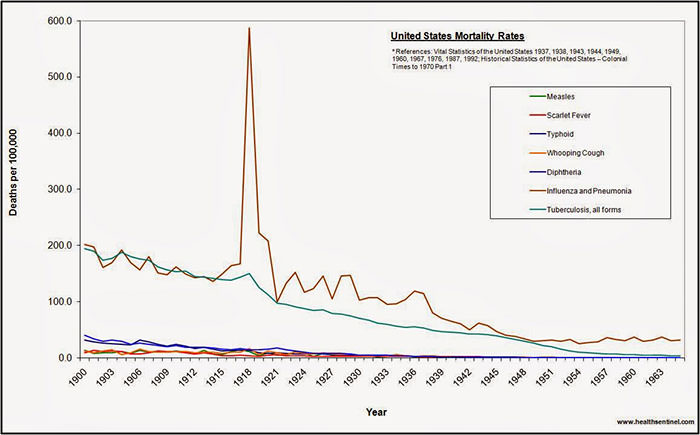
The still growing COVID-19 pandemic has reminded me of a question I've batted in my head a few times. In 1918 and 1919 a global influenza pandemic killed on the order of 50 million people worldwide. The scale of the jump in flu deaths in the U.S. can be seen in the below plot. That's more than the number of civilians and military personnel estimated to have been killed during World War I. Yet despite this, it would seem that there has been very little impact on culture (at least the culture I am aware of).
Wednesday, February 26, 2020
MGI Deconstructs the Sequencer
At some fancy restaurants one can get a "deconstructed dish". As I understand it, as I don't frequent such restaurants, a deconstructed BLT would have the bread, bacon, lettuce and tomato each as their own individual item, but prepared in a novel way which highlights the strengths of each ingredient. When I got a preview last night of Rade Drmanac's closing AGBT talk on achieving a $100 human genome (reagents price only), that was the vision I had: Drmanac and his team have created their Tx system by deconstructing the optical high throughput sequencing-by-synthesis instrument.
Saturday, February 22, 2020
CoolMPS Revealed
Having summarized MGI's announcement they are launching into the U.S. market this spring and started digging into the performance characteristics of MGI's instrument lineup, let us now turn to their BioRxiv pre-print on the CoolMPS chemistry, as it has many useful technical details.
MGI Dual Drop of CoolMPS News Ahead of AGBT
Friday morning I got excited because a preprint showed up at BioRxiv detailing the CoolMPS sequencing technology from MGI (aka BGI aka Complete Genomics). First announced in Fall 2018, this approach sounded, well, cool. Using fluorescently labeled antibodies specific to each reversible terminator seemed like a crazy pipe dream. So getting a good look at it in a manuscript is an event! But then Friday afternoon MGI had a second big pre-AGBT reveal: launch of their sequencing systems in the U.S. later this year. Below is a quick run-down of the sequencer announcement; the pre-print has many details I'm still parsing.
Subscribe to:
Posts (Atom)